
#ANZMarist150: From a Marist classroom to Headmaster of Sacred Heart College - Patrick Walsh on being formed by the Brothers and forming the next generation
From a young student sitting in a Marist classroom to becoming the Headmaster of Sacred Heart College - Aotearoa New Zealand’s largest Marist school - Patrick Walsh’s journey has been deeply shaped by the values and spirit of the Marist tradition.
A former student of Vermont Street School and St Paul’s College, Patrick experienced firsthand the influence of the Marist Brothers who accompanied him during his formative years. Their presence, commitment, and example not only shaped his own personal journey but also inspired the vocation he would later choose - a life dedicated to education and the formation of young people.
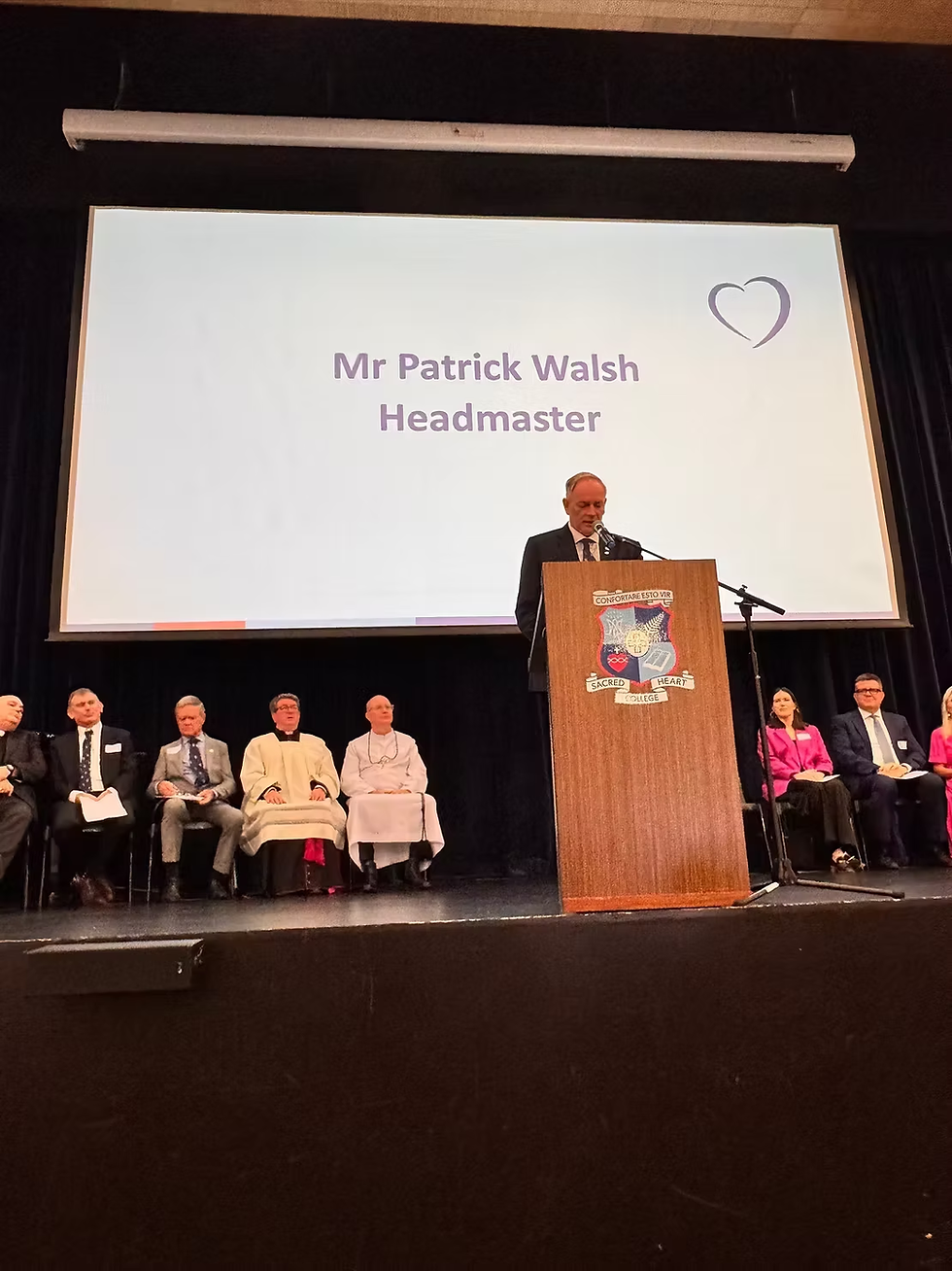
When Patrick became the Headmaster of Sacred Heart College, he carried with him a clear mission: to ensure that the Marist spirit remained at the heart of the school’s identity - not simply as a tradition to preserve, but as a way of being that shapes how students learn, relate to one another, and serve their communities.
For him, the true measure of that mission is seen in the young men who graduate from Sacred Heart. Patrick hopes that every student carries with them the values and spirit they have experienced during their time at the college, living out the school’s guiding philosophy,“Enter to learn, leave to serve.” It is a mission he remains deeply committed to as he continues to strengthen the Marist identity and formation of the school.
As Marist education in Aotearoa New Zealand celebrates 150 years, The Star Post sat down with Patrick to reflect on his own Marist journey, the initiatives shaping life at Sacred Heart College today, and his hopes for the future of Marist education.
Tell us a little about your journey as an educator. What led you to Sacred Heart College and into the Marist world?
My connection with Marist education began long before I became a teacher.
I was first educated by the Marist Brothers at Vermont Street School. From there I went to St Paul’s College, where I completed my secondary education from Year 9 through to Year 13.
It was at St Paul’s that one of the Brothers encouraged me to pursue teaching and enrol at the Loreto Hall, Catholic Training College. I accepted that invitation and was inspired by the many Marist Brothers who had taught me throughout my formative years.
Given my own Marist education and formation, returning to a Marist school was something very special.
My first teaching position was at Rosmini College in Takapuna, where I eventually became Director of Religious Studies. During that time, I also completed a law degree.
In the early 1990s, I moved to De La Salle College in Māngere as Deputy Principal, eventually serving under Sir Patrick Lynch, who went on to become the head of Catholic education in Aotearoa New Zealand.
After spending ten years at De La Salle, including a period as Acting Principal, I was appointed Principal of John Paul College in Rotorua, where I served for 19 years. My four children attended the school and grew up there, so it became a very significant part of our family’s life.
After nearly two decades, I felt it was time for a new challenge.
When the opportunity arose to become Headmaster of Sacred Heart College, it felt like a natural fit. Given my own Marist education and formation, returning to a Marist school was something very special.

I have now been at Sacred Heart for just over four years and have thoroughly enjoyed becoming part of this remarkable community.
Sacred Heart is one of the few Marist schools where the Brothers are still actively involved in daily school life. What does their presence mean for your school community?
We are incredibly fortunate. Having the Brothers living on site and continuing to contribute to school life is a tremendous blessing. Some remain involved in teaching, others assist in the hostel, celebrate Masses and continue to share the Marist spirit with both staff and students.
At the same time, we have to recognise that this won’t last forever.
I have worked in Catholic schools where the Brothers gradually left and there wasn’t a clear succession plan. That experience taught me the importance of preparing lay leaders to carry the Marist tradition into the future.
While we deeply value the Brothers’ presence today, we also have a responsibility to ensure that when there are no longer Brothers in our schools, the Marist spirit remains just as strong and vibrant.
How do you think that can be done?
I think there’s an opportunity for us to invest much more intentionally in the formation of lay leaders.
The Star of the Sea Province already provides valuable formation programs. There may also be opportunities to draw inspiration from formation programs offered by other religious congregations, such as the Jesuits and the De La Salle Brothers.
While we deeply value the Brothers’ presence today, we also have a responsibility to ensure that when there are no longer Brothers in our schools, the Marist spirit remains just as strong and vibrant.
For example, I completed a three-year Buttimer Institute programme in San Francisco through the De La Salle tradition.
The first year explored the life and times of St John Baptist de La Salle. The second focused on his educational philosophy, while the third examined his spirituality.
Everyone who attended made a commitment to return to their schools equipped to lead liturgies, provide professional development and actively foster the Lasallian charism within their communities.

I think a program like that would be an outstanding initiative for the Marist world.
By intentionally forming lay leaders, we can ensure that the Marist mission continues to thrive for generations to come.
This year marks 150 years of Marist education in Aotearoa New Zealand. Beyond longevity, what does this milestone represent to you?
One of the most significant aspects of the Marist legacy in Aotearoa New Zealand is the strong relationship the Marist Brothers established with Māori communities from the very beginning.
Today, there is an important national conversation around Te Tiriti o Waitangi, Aotearoa New Zealand’s founding document, and the relationship between the Crown and Māori. The Marist Brothers understood the importance of building genuine partnerships with iwi and hapū and that commitment continues to be reflected across Marist schools throughout Aotearoa. (In Māori society, an iwi is a large tribe, while a hapū is a sub-tribe or clan, forming the primary political and social units of traditional Māori life).
One of the most significant aspects of the Marist legacy in Aotearoa New Zealand is the strong relationship the Marist Brothers established with Māori communities from the very beginning.
Another enduring legacy is the trust that families continue to place in Marist education.
Schools like Sacred Heart have consistently attracted strong enrolment because parents are seeking more than academic success. They want their children to receive a Christian education grounded in the Marist tradition and shaped by the Marist values.
While our school continues to modernise - embracing new technologies and preparing students for an ever-changing world - our foundations remain unchanged. Families are looking for schools that have a strong moral compass, enduring values and a clear sense of purpose.
That is the taonga (gift) we have inherited from St Marcellin Champagnat. It has been handed down through generations of Marist Brothers and, more recently, by committed lay educators who continue to carry that mission forward.
One hundred and fifty years later, those values remain just as relevant as they were when the first Marists arrived in Aotearoa New Zealand.

Sacred Heart College has a strong Māori identity, alongside its Catholic and Marist heritage. How does the college ensure that these cultural identities are not simply acknowledged, but genuinely celebrated and woven into the life of the school?
The strong emphasis here is that Māori students ought to be proud of their culture, their language, and who they are. They should be equipped to walk with their heads held high in both the Māori and Pākehā (European) worlds.
That means embracing a Pākehā education and all that it offers, while also seeing the world through the lens of their traditional values, including manaakitanga and their ancestral traditions.
We recognise and respect Māori as tangata whenua - the first peoples of Aotearoa - and acknowledge that everything we do must honour that relationship.
The boys take great pride in kapa haka because it is a very visible expression of their culture and language. It is used to welcome visitors to the college, during chapel celebrations when we recognise old boys who have passed away, and at our Masses as a form of waiata or song.
There are many ways throughout the college where we express Māori culture, tradition, and our commitment to the partnership with the Crown. We recognise and respect Māori as tangata whenua - the first peoples of Aotearoa - and acknowledge that everything we do must honour that relationship.
As the Headmaster of a Catholic, particularly a Marist, school, how do you translate Marist values such as humility, presence, and service into daily school culture, especially in a modern society where these values do not always seem to be prioritised?
I think Catholic schools do need to be countercultural. We live in an environment where there is often a strong focus on materialism, individualism, ego, and greed - and ultimately, those things do not lead to happiness.
The emphasis here at Sacred Heart College is captured in the phrase: “Enter to learn, leave to serve.”

Every boy is expected to complete at least six hours of voluntary service each year, although most do much more than that.
We have a very active Young Vinnies group. The students grow vegetables at Gate Four, harvest them, and donate them to local food banks. They also run campaigns such as collecting pyjamas for people in need.
The emphasis here at Sacred Heart College is captured in the phrase: “Enter to learn, leave to serve.”
We also support a local restaurant called Everybody Eats, which provides meals for people in the community who cannot afford them. Local businesses donate the food, and our boys assist with preparation and service.
Another initiative that is particularly special is our twinning relationship with Marist Brothers Schools in Suva, Fiji. This has been operating for nearly three years. Teachers from Suva visit Sacred Heart College for professional development, and teachers from Sacred Heart travel to Suva to support their colleagues there.
How do you respond to students who may feel disconnected from a religious identity but are still seeking meaning and belonging?
We are currently running a sacramental program, and we have 30 to 40 boys who want to become part of the faith community at Sacred Heart College.
These are boys who were not raised Catholic, but through their experiences here - whether through Young Vinnies, attending Mass on Thursdays, or through the work that Brothers and others do in the hostel - they have developed a connection with the Catholic Marist community and a desire to explore their faith further.

Under our integration agreement with the Crown, we are able to enrol 5% non-preference students. Each year, within that group, we typically have 30 to 40 boys who take this next step. Some may have only been at the college for a year, while others may be in their final year of school.
They come to us and say, “Actually, we now want to become fully part of this Catholic Marist community.” They choose to join the Catholic Church, receive the sacraments, and embrace the Catholic identity and Marist spirituality. For me, it is a powerful example of how a student’s experience of community, service, and belonging can open the door to faith.
What has been one of the most difficult leadership decisions you have had to make as Headmaster, and what did it teach you?
I think one of the most difficult decisions was introducing the Māori name of the College alongside the existing Sacred Heart College sign.
The name Sacred Heart College is deeply embedded in the hearts and minds of our old boys, current students, and the wider community. When we made that decision, there were some people who questioned it and said they did not want the Māori name included.
However, in my view, that position was contrary to our obligations under Te Tiriti o Waitangi. It did not honour our Māori students and families at Sacred Heart College. Rather than diminishing the name of Sacred Heart College, I believe the Māori name actually enhances and enriches our identity.
What Catholic schools will be called to do, and what their core purpose is, is to shape young people of character for the future.
We did receive some criticism, but I had the full support of the Board of Trustees and the wider Sacred Heart College community.
What do you think the next 50 years of education will demand from schools like Sacred Heart and other Catholic schools?
I think education will become less and less about simply transmitting knowledge. Technology, particularly with the advancement of artificial intelligence, will increasingly take care of that.
What Catholic schools will be called to do, and what their core purpose is, is to shape young people of character for the future.

That means forming young men who are rooted in the Gospel message, who have a strong sense of community, and who leave school not simply to achieve personal success, but to use their gifts to benefit others.
These are the qualities our society needs. When you look at Aotearoa New Zealand and the wider world, there is so much division, racism, hatred, and materialism. Catholic schools, including Sacred Heart College, must continue to offer an antidote to those challenges.
I believe that is why they continue to be attractive to parents.
Young men today are exposed to many competing messages about success, identity, and masculinity, particularly through online platforms. How does Sacred Heart College help students navigate these influences and develop into confident, compassionate, and respectful young men?
They are significant challenges. What we focus on here is the partnership between the school and parents.
There are many benefits that come from the internet and technology, but there is also a very dark side. It can lead to addiction, distorted views of relationships, unhealthy attitudes towards women, and misunderstandings around issues such as consent.
One of the key messages we share with parents is that they often have great concern about their son’s physical safety when he is outside the home, but they should also be thinking about his wellbeing when he is alone in his bedroom, behind a computer screen.
We believe parents and schools need to work together to carefully support and guide young people in navigating that space.
One of the key messages we share with parents is that they often have great concern about their son’s physical safety when he is outside the home, but they should also be thinking about his wellbeing when he is alone in his bedroom, behind a computer screen.
We regularly invite experts into the College to run workshops on healthy living. These conversations are not only about physical health and wellbeing, but also about building healthy relationships, respecting others, and growing into mature and responsible young people.
When students leave Sacred Heart College, what do you hope they carry with them that cannot be measured on a report card?
I hope they carry with them those innate Marist values and characteristics.
They carry with them the spirit of Mary - a strong work ethic, humility, a deep sense of community, and an understanding of family.
These values also resonate strongly with Māori and Pasifika cultures, particularly through concepts such as manaakitanga, which speaks of generosity, care, and giving to others.
These are the hallmarks of a Marist man.

Interestingly, when you speak with business leaders, they are often less focused on whether a student achieves straight A grades. What they value most is a young person with a strong work ethic, someone willing to learn, someone prepared to contribute to others, and someone who will become a good citizen.
Academic achievement is important, but it is secondary to those qualities.
How has leading Sacred Heart College changed you personally?
It has given me a strong sense of optimism.
When I read the newspaper, there are often negative stories about young men - whether they involve poor behaviour, violence, or criminal activity. But my experience at Sacred Heart College is that the vast majority of teenage boys are actually well-rounded young men who want to make a positive contribution to society.
These values also resonate strongly with Māori and Pasifika cultures, particularly through concepts such as manaakitanga, which speaks of generosity, care, and giving to others. These are the hallmarks of a Marist man.
They have the potential to become wonderful people, husbands, fathers, and members of their communities.
A great example was our Head Boy last year. It was wonderful to see him not only playing First XV rugby, but also attending Mass every Thursday lunchtime, being actively involved in our Tongan cultural group, supporting St Vincent de Paul, and participating in the choir.
When you bring all of those elements together - academic achievement, faith, culture, service, and community - you see the qualities of a true Marist man.

He has now gone on to university to study medicine, and I believe he represents the type of young person we hope to form at Sacred Heart College.
Finally, in one word or sentence, how would you describe the legacy of Marist education in Aotearoa New Zealand?
For me, the legacy of Marist education has to be forming young men of character, built on the Gospel and the Marist tradition.


Comments